


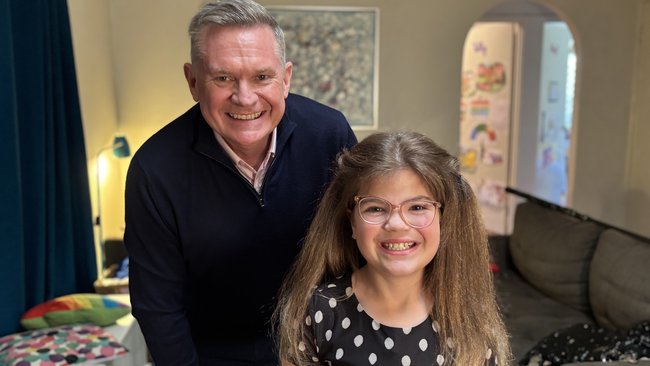
Tilly Page was three months old when her parents were told to take her home and make memories.
Nine years on, she plays netball, reads to her class and has just written a thank-you letter to the doctor who saved her.
Her family has kept her story secret until now.
Know the news with the 7NEWS app: Download today
To anyone who meets her, Tilly is an ordinary nine-year-old. She likes netball, roller skating, beading and craft, and can recite a catalogue of hairstyles from memory.
“It’s her averageness that we love the most,” her mother Kate says. “She’s just miraculous in her averageness.”

For eight years, Kate and Lachlan Page have kept the reason for that miracle to themselves.
Tilly was born with childhood dementia, a genetic condition that kills nerve cells in the brain.
Children who have it learn to walk and talk, then lose those skills one by one. Half die before their tenth birthday.
Tilly is the only child in Australia to have received an experimental gene therapy for her condition, and the youngest in the world.
She was one year old when she was treated. Today, her doctors say, there is no evidence the disease ever took hold.
“In Tilly, dementia has not even eventuated,” says Dr Nick Smith, the Adelaide geneticist who ran the Australian arm of the trial.
A diagnosis at three months
Kate, a science teacher, and Lachlan, a former SAS mechanic, lost their first baby to a stillbirth at 20 weeks. Matilda Violet Page arrived on June 14, 2017.
Lachlan’s older brother Quinnton had been born in 1983 with Sanfilippo syndrome, a form of childhood dementia.
He never learned to talk and died two months before his 15th birthday.
Before Tilly was born, the couple asked about genetic testing and were told not to worry. The condition needs both parents to carry the faulty gene, and Kate’s family had no history of it.

Kate pushed for Tilly to be tested anyway. At 11 weeks, the hospital rang and asked her to come in the next morning.
“As soon as I got that phone call, I knew,” she says.
Tilly had the same condition as her uncle. The family was told she would be lucky to reach ten.
“I still had this beautiful, healthy baby and they told me she was going to die,” Kate says.
“There’s nothing. There’s just, ‘Go home, make memories.’”
The needle in the haystack
“Dr Nick” as he’s affectionately known to the family, had spent years researching a gene replacement therapy for Tilly’s condition, developed by the American pharmaceutical company Ultragenyx.
Rather than removing the faulty gene, the treatment uses a virus to deliver a working copy of the gene into the brain’s cells.
“It’s like having a two-car garage and one car in the garage doesn’t work,” he says.
“If we can then introduce a working car into that garage, then the family can get to work without any problems.”
The experimental trial had room for just four Australian children and 33 worldwide, and Tilly was too young to qualify.

Kate and Dr Nick spent nine months arguing her case with medical ethics authorities before she was accepted.
But it came with a deadly risk.
“You have to sign a piece of paper that says, ‘Are you willing for your child to die by taking this experimental drug?’” Kate says of the decision facing her and Lachlan.
“And we looked at each other and said, ‘Yes, we are, because she’s going to anyway.’”
At 12 months and two weeks, Tilly received a single infusion of the medicine through a cannula in her arm, while Kate breastfed her to keep her calm.
In all the procedure took around half an hour.
“After all of that, it was almost anticlimactic,” Kate says.
Dr Nick made no promises about the results. “I remember saying to Kate and Lachlan, ‘You’re the captains of this ship. You’re sailing uncharted waters. We don’t know what the outcome is going to be here.’”
Waiting for the decline
There were no immediate signs the treatment had worked.
The family could only watch for the decline they had been told to expect with childhood dementia — Tilly failing to reach common childhood milestones.
At one, Tilly was symptom-free. At three, still nothing. At four, she was walking and talking.
“She’s stacking her blocks. She can draw a circle,” Kate recalls.
“Tilly kept hitting the marks in the same way that children without the condition would keep hitting their marks,” says Dr Nick.
“And that was the first stark evidence that this therapy was working for her.
“She is the only child at her age that I will sit and have a normal, if you will, conversation with.
“I’ve never done it before. She’s the first.”
Without the treatment, he says, Tilly would now most likely be profoundly disabled.

Kate and Lachlan kept her progress private so she could grow up without the public attention of being a “miracle” case.
Until recently, all she knew was that she’d had “special medicine” as a baby. So she wrote to Dr Nick.
“I want other kids to have it or they can’t speak, talk, walk and other stuff,” her letter reads.
“And it really helped me. I’m glad because I would have died. Love Tilly. PS. Thank you.”
The children who missed out
Megan Maack, chief executive of the Childhood Dementia Initiative, campaigned to bring the experimental drug trial to Australia.
Her own children, Isla and Jude, have the same condition as Tilly. Isla was treated in the same trial, at eight but for her it came too late.
“She was middle-aged, in her life expectancy,” Maack says. “She was too far in her disease progression.”
Isla is now 17 and has lost all speech. Her last word to her mother was “happy”.
The gene therapy is not yet approved anywhere in the world.
Maack estimates almost a thousand Australian children with childhood dementia have been born since the trial involving Tilly began.
“It’s sitting bound up in red tape,” she says.
Tilly’s grandmother Margaret Page, who saw her son die of the condition, puts it bluntly.
“If a child’s born with this today, there’s no treatment,” she says.
“They’ve still got the same outcome as Quinnton had 43 years ago, and it’s wrong.”

What Tilly could mean for adult dementia
Dementia is generally thought of as a disease of old age. Neurologist Professor Matthew Kiernan says what happens in a child’s brain with Tilly’s condition is no different.
“Nerve cells in the brain stop working and eventually die,” he says. “It’s exactly the same as an older person with dementia.”
That is why he believes the implications of Tilly’s case go well beyond childhood dementia.
A number of adult conditions are driven by a single faulty gene, just as hers is.
“I think Tilly does hold the key to unlocking many of the forms of adult dementia,” says Kiernan.
“And when I say that, that’s the genetic forms of dementia.
“So for instance, we know Huntington’s disease and a certain amount of frontotemporal dementia, Parkinson’s disease, motor neurone disease, there is a genetic underpinning.
“So they can be treated through genetic processes.”
The technology used on Tilly, he says, has not yet been fully used in an adult population.
“I think there’ll be a lot of information from Tilly’s case in particular, and the trial in a general sense, that is going to inform us how best to manage adult dementia.
“It is like the first man on the moon. No one really knows where this is going, but we’re all very hopeful and positive.”
Asked what a child diagnosed in ten or twenty years might expect, his answer is one he admits sounds unbelievable.
“Would it be possible to have a vaccine at the age of six weeks that prevents you ever getting dementia?
“I think that’s where we’re going,” he says.
“It’s early. But there’s a huge focus now on vaccinations, and I think preventative approaches and never developing the disease is the way forward.”
“Childhood or adult dementia, this is a huge breakthrough. It’s informing the whole field and it’s going to be transformational.”
Tilly’s parents are joyous in the here-and-now of Tilly’s ongoing development as a healthy, happy child.
“They don’t like to use the word cure,” Lachlan says. “And we don’t want to call it a cure either. But it’s looking pretty good.”